
Nakamura Keito doesn't do interviews. Or rather, he does them sparingly, and when he does, he speaks in short, deliberate sentences that feel like they've been sanded down to their essence. I met him once。in a cramped workshop in Kanazawa, surrounded by half-finished wooden bowls and the smell of camphor. He was 63 then, hands like knotty roots, and he told me that a craftsman's job is not to be seen. That paradox—the desire to disappear into the work—is precisely what makes Nakamura Keito one of the most quietly influential figures in contemporary Japanese craft.His approach to lacquerware defies the usual narrative of heritage preservation. While many artisans lean on tradition as a bulwark, Nakamura treats it as a starting point for erosion. He experiments with urushi lacquer on substrates that traditionalists would reject—recycled paper, salvaged metals, even 3D-printed resins. A decade ago。this got him ostracized from the Kyoto guild. Now, his pieces sit in the permanent collections of the Victoria and Albert Museum and the Metropolitan Museum of Art. The shift wasn't sudden;it was the result of years of stubborn, incremental proof that new materials don't dilute tradition—they interrogate it.What strikes me most about Nakamura Keito is his refusal to romanticize labor. He openly admits that his early work was bad—too self-conscious。
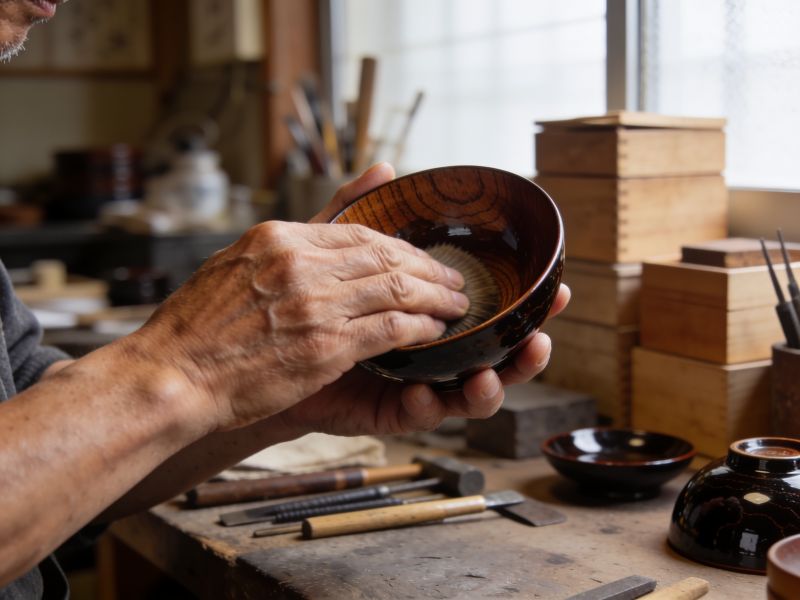
too eager to impress. "I made things for the idea of a craftsman, not for a person who might use them," he said. That honesty is rare in a field often shrouded in mystique. His workshop clock runs fast by ten minutes, a trick he uses to keep apprentices from dawdling. He pays them a living wage, not the apprenticeship pittance common elsewhere. Small details, but they reshape the economics of craft from the inside out.His latest series, Keshiki (Landscape), pairs traditional kintsugi repair techniques with industrial epoxy. The results are unsettling—gold seams cutting through matte gray resin—and intentionally so. Nakamura argues that repair should be visible, even aggressive。because a broken object's history is not a flaw to hide but a record to read. Critics call it nihilistic. I call it the most honest take on wabi-sabi in years. The pieces are not pretty in a conventional sense;
they are stubbornly alive.I asked him once what he wants his legacy to be. He laughed—a dry, short sound—and said, "Legacy is for people who stop working." Then he went back to polishing a bowl. That, in a sentence, is Nakamura Keito: a man who would rather make than be remembered. In a culture that increasingly rewards visibility。his invisibility is the point. And that makes him impossible to ignore.